
SITUATION UPDATE (as of 6/11/26 @ 930AM EDT)
Hantavirus Outbreak Aboard the MV Hondius
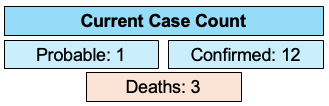
Brief Summary. On May 2, 2026 the World Health Organization (WHO) received notification of a cluster of severe respiratory illnesses aboard a Dutch-flagged expedition vessel. The ship, the MV Hondius, had departed Ushuaia, Argentina on April 1, 2026 with 149* individuals onboard (88 passengers, 61 crew members), making numerous stops as it sailed across the South Atlantic. Originally, three cases were reported to the WHO on May 2, including two deaths (Cases 1 & 2) and one critically ill passenger (Case 3). On that same day, the WHO reported that the third case, who was hospitalized in intensive care in South Africa, tested positive for hantavirus infection. Since then, one additional death has been reported (Case 4), along with nine other cases (Cases 5-13), for a total of 13 cases (12 confirmed, 1 probable). Cases have reported respiratory and gastrointestinal symptoms and fever. At least four of the cases rapidly progressed to pneumonia, acute respiratory distress, and shock. Since the initial WHO alert, it has been reported that Cases 1 & 2 went on a bird watching trip in Argentina, Chile, and Uruguay prior to boarding the vessel. This included travel to areas known to have the species of rat capable of carrying the Andes hantavirus species. Investigations into the movement of the first two cases remain ongoing.
The WHO assesses the overall public health risk of the ongoing outbreak as “low.” Current response priorities include caring for the ill that remain hospitalized and preventing any further spread of the virus. Monitoring of passengers is ongoing, who have since disembarked the vessel and repatriated to their homes, where they will undergo quarantine for 42 days.
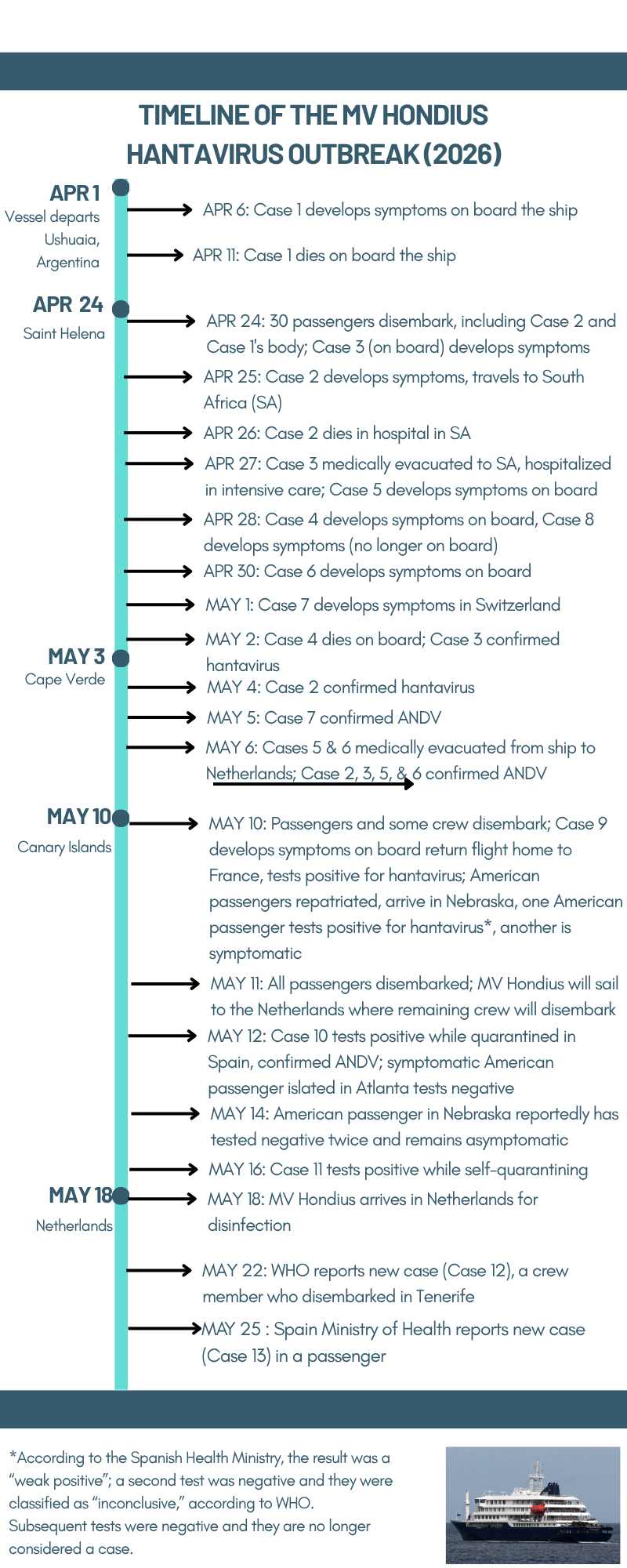
*There are conflicting reports of the number of passengers who were onboard, with WHO reporting 147 and the ECDC reporting 149. Oceanwide Expeditions, the owner of the MV Hondius, reported 149 total passengers.
Hantavirus Information. Hantaviruses are primarily transmitted through contact with the urine, feces, or saliva of infected rodents or through contact with contaminated surfaces. Infection with hantaviruses can lead to hantavirus pulmonary syndrome (HPS), with symptoms typically occurring 2-4 weeks after initial exposure, but can be as late as eight weeks post-exposure. Early symptoms of HPS include fatigue, fever, and muscle aches, which are then followed by respiratory symptoms, including coughing and shortness of breath. Hantavirus infection can also cause Hemorrhagic Fever with Renal Syndrome, leading to shock, hemorrhage, and kidney failure. Hantavirus infections have a case fatality rate of <1-15% in Asia and Europe, and are as high as 50% in the Americas. For reference, some case fatality rates for other respiratory viruses include COVID-19 (around 1% in the general population, 37% for those in intensive care), severe acute respiratory syndrome (SARS, 11%), and Middle East Respiratory Syndrome (MERS, 36.5%).
There are several different species of hantaviruses, including the Andes strain, which is found in South America. Although rare, there have been instances of human-to-human transmission of the Andes strain, including in Argentina in 2018/2019, which resulted in 34 confirmed cases and 11 deaths, for a case fatality rate of 32%. This outbreak in Argentina resulted from a single introduction of the Andes strain from a rodent into humans, and was largely driven by three symptomatic and infectious cases who attended large social events. During this outbreak in Argentina in 2018/2019, the reproductive number was reported to be around 2.12 (eg, one infected person typically leads to two additional cases in a susceptible population) prior to the implementation of control measures (eg, isolation and quarantine), which decreased to 0.96 with control measures.
There is no specific treatment or vaccine for hantavirus infection. Early access to supportive care, such as management of respiratory, cardiac, and kidney complications, is critical. Additionally, prompt detection and isolation of cases can prevent further transmission, including to close contacts and healthcare workers.
Pertinent Situation Reports and Briefings
NEJM Evidence. Andes Hantavirus Outbreak on a Cruise Ship, 2026. (5/20/2026)
WHO Disease Outbreak News. Hantavirus cluster linked to cruise ship travel, Multi-country. (5/13/2026)
Preliminary analysis of Orthohantavirus andesense virus sequences for a cruise-ship related cluster, May 2026. (5/10/2026)
ECDC. Weekly Bulletin: Communicable Disease Threats Report. (5/13/2026)
WHO Disease Outbreak News. Hantavirus cluster linked to cruise ship travel, Multi-country (5/8/2026)
Oceanwide Expeditions. Press Update. (5/7/2026)
WHO. Media briefing on hantavirus outbreak (5/7/2026)
ECDC. Hantavirus-associated cluster of illness on a cruise ship: ECDC assessment and recommendations (5/6/2026)
WHO Disease Outbreak News. Hantavirus cluster linked to cruise ship travel, Multi-country (5/4/2026)