
Ebola - Bundibugyo Virus
As of early June 2026 the DRC has been hit with an outbreak of Ebola in the East portion of the country.
Headlines
Ebola cases and deaths due to the Bundibugyo virus outbreak in the Democratic Republic of the Congo (DRC) continue to increase by the hundreds each week. It is the second-largest Ebola outbreak in history anywhere and the largest the DRC has ever recorded. The number of cases this week, 7,404, is 8.2% more (+561 cases) than the previous week, but constitutes a lower rate of increase than the 9.5% growth in cases recorded last week relative to the week prior. The number of deaths, currently at 3,577, increased by 8.1% (+257 deaths) this week, lower than the 8.9% increase the previous week.
The Full Story
9-17-26 | Ebola infections caused by the Bundibugyo virus outbreak in the Democratic Republic of the Congo (DRC) have surpassed 7,400 cases and 3,500 deaths. This is the largest Ebola outbreak ever reported in the DRC and the second largest in recorded history. The current number of confirmed cases – 7,404 – is 8.2% more than what was reported last week (+561 cases). This is slightly slower growth than the 9.5% increase seen the week prior. The number of deaths, currently at 3,577, increased by 8.1% this week (+257 deaths), lower than the 8.9% increase the previous week. In addition to the increase in confirmed cases, the number of suspected Ebola cases increased by 29% or 94 cases, from 329 last week to 423 this week.

Graphics are informed by data available up to the time of Tracking Report publication. All data are provisional and subject to change. Source: WHO, DRC Situational Reports
Over the past week, there have been confirmed cases in 35 health zones, with the outbreak spreading to a seventh province, South Ubangi. Over the entire outbreak, which began in May, there have been 62 health zones impacted with at least one case reported in seven provinces. The Africa CDC noted during its most recent press conference that 13 of those 62 health zones have not reported a case within the past 21 days – an encouraging sign that transmission is decreasing. Ituri Province remains the most affected, accounting for 77.7% of all confirmed cases. While transmission appears to be slowing in Ituri, the province continues to report high numbers of cases, including approximately 300 cases and 160 deaths in the past week. Transmission dynamics in each province differ, with some experiencing sustained transmission (eg, Ituri and
Haut-Uélé), while others are experiencing more sporadic transmission (eg, Tshopo) or no recent transmission (eg, South Kivu).
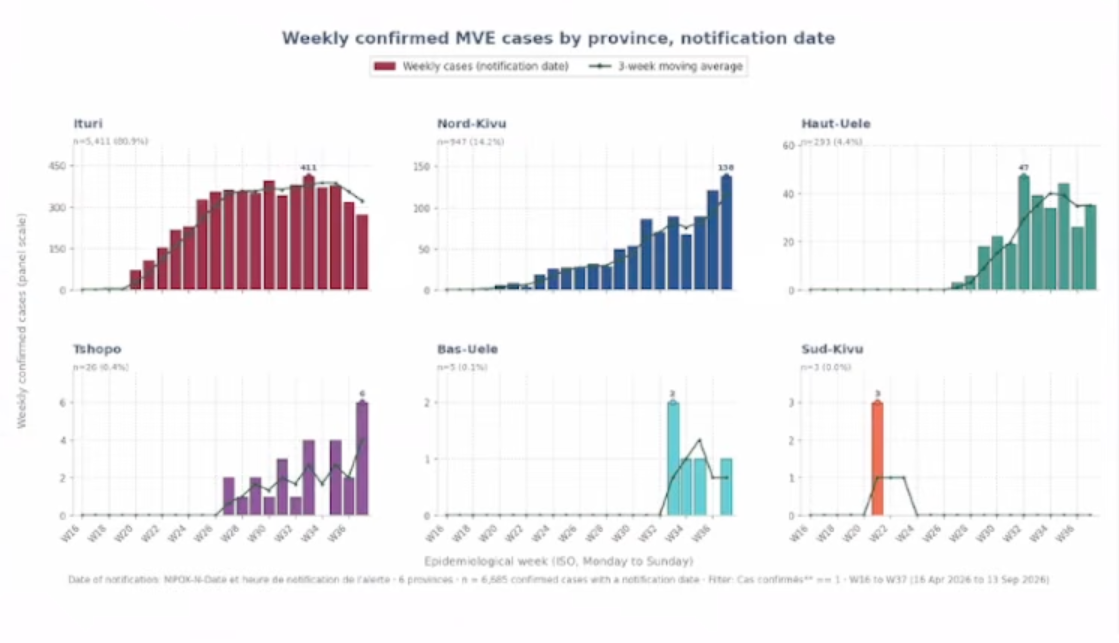
Screenshot from video provided by Africa CDC
The size of the outbreak is likely drastically underestimated due to insufficient contact tracing. According to the Africa CDC, they are expecting about 60 contacts per case, and the actual number of cases followed up is well below that. Of the contacts listed, the follow-up rate is 87.4%, below the 95% target. When the Africa CDC takes into consideration the contacts that are not listed for follow-up, the rate drops to only 26.8% of expected contacts identified and under follow-up.